"I can't have my happiness made out of a wrong to someone else."
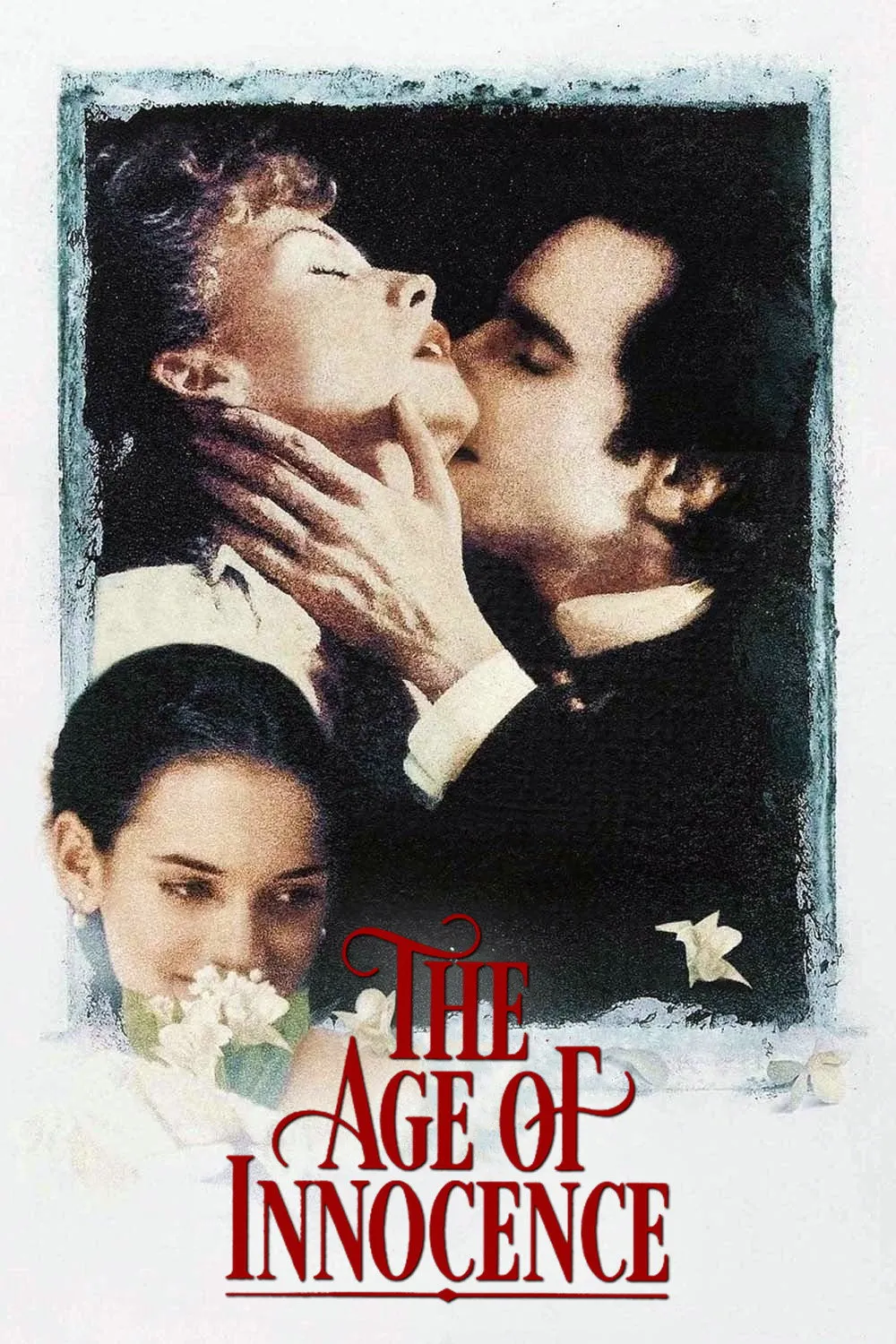
The Age of Innocence
The Age of Innocence is a movie with narrative properties similar to that of a book. Many movies use narration as a supplement, a stylistic choice, but in the Age of Innocence, the narration serves to remind the viewer that he/she is on a guided tour, the subject of which is 1870’s “high society” in NY.
The camera guides our eyes, focusing our attention on the details of the living spaces the characters navigate. We are not just interested in the personal lives of the characters (although that is a main focus); we are sightseeing – covering major landmarks, but sparing enough time to smell the roses. The physical space in this movie is manipulated to reflect the emotional atmosphere, and at times the social hierarchy, of the characters within it. The elements that are dominant in this manipulation of space are color and composition. The passage of time is represented through various techniques that highlight the storytelling aspect of the narration, rather than attempting to imitate the flow of real time. The colors in The Age of Innocence progress along with the movie, creating an emotional timeline. Early in the movie they are bright and wildly diverse, primarily pastels and brilliant floral sprays. As time continues the colors get darker. Newland’s relationship with May becomes more and more wooden, and his separation from Ellen suffocating. The colors fade from celebratory radiance, to earth tones and black. The lighting also gets dimmer.
The two women in Newland Archer’s life are portrayed differently by the settings in which they appear. During the beginning of the movie, May is often overwhelmed by the background. Her white skin and dark hair are usually washed out by the colorful displays around and behind her. She is shown in expansive, formal spaces, sitting or standing in a restrained manner. Toward the beginning May is also shown in natural light most of the time, and when she is indoors, the lighting is as close to the all-illuminating qualities of natural light as possible. The flatness of the lighting and the expansive feeling of the space around her contribute to her character’s diminutive nature. The refusal of the lighting and mise-en-scene to highlight her, communicates that she is wholly a part of the physical structure (and confinement) of Newland’s world. She has no independence.
Ellen is shown in a very different light – literally as well as figuratively. She is portrayed in the movie as unconventional and somewhat lascivious. This shows in the colors and spatial design of each scene in which she appears. She often appears in earth tones or red, colors which are often associated with sexuality and passion. When she speaks with Newland their surroundings are often intimate; the surrounding space is usually small and the lighting usually soft. Ellen’s house is full of rich earth tones and soft fabrics. In one scene she sits in a soft armchair talking with Newland in front of a fire. The fire is seen behind Ellen’s body, almost growing out of it. Ellen is frequently the focus of dramatic lighting as well. In one of the opera scenes in the movie, after it is known to us that Newland has developed an infatuation with Ellen, she is momentarily backlit by the lighting on the stage. It appears as though the stage lights are actually on her – completely divorced from the opera stage.
May is shown in one scene framed by a fountain in the same way Ellen is framed by the fire. The fountain is a restrained outpouring of water, a metaphor for the relationship Newland has with May. They both play according to the rules, and May at times is even difficult to discern from the rules. In the middle of the movie, when the restrictions in their relationship are more obvious, May sits in a huge, wooden chair, knitting. Her slight figure is almost consumed by the enormity of the chair. The armrests are thick and too high for her arms to rest comfortably on them – while the back of the chair rises stolidly behind her head. Just as her personality is subsumed by the structure of the society in which she and Newland live, the chair seems to dwarf and distort her.
Later in the movie there is a moment when May reveals herself to have more of a mind than she let on. In this scene Archer has gathered his courage to tell May about his love for Ellen. May already knows, however, and deftly outmaneuvers him – forcing him to maintain silence and keep up the charade of fidelity. In this scene there are three chairs: one small and thin with low armrests, and the other two are similar to the one that overwhelmed May’s figure earlier. May sits demurely in the small chair, her body obscuring most of it. She is in control, no longer swallowed by the system. She has suddenly seized a moment of consciousness and bent the rails of the track so they run her way.
Up to this point, Newland Archer has seemed to be the aloof one, participating in the rules of his world yet apparently able to walk away at any moment. In May’s confession that she is pregnant, she strips him of his power and reveals that she is not as simple minded as she may appear. A previous scene shows May to be an excellent archer, but two onlookers snidely remark that the archery target is “the only mark she’ll ever hit.” In this scene, however, she proves that she has indeed hit her mark – dead center. While it may not bring her happiness, she has procured for herself a husband who is loyal and stable in all formal affairs. Yet Newland is the Archer of importance, and with his sights on two targets his arrows consistently fall short of the mark. In this scene of confrontation between May and Newland, the latter is sitting in one of the huge, solid wooden chairs in the room – he has now been consumed by the strict rules of propriety in their social group. The transitions in this movie are in line with the narrative properties I alluded to earlier. They speed up and slow down the story, covering all of the important elements. During the dinner scenes there are a number of montages that involve shots of each person’s place settings dissolving into each other. One shot will be of a hand placing an elaborate plate on the table, that scene will dissolve into a shot of the same person’s silverware, dissolve to their appetizers, dissolve to their wine glass, etc. Then there will be a montage of the other person’s place setting – their food, their silverware, and so on. These montages have two purposes: the first is to give the viewer a sense of superlative pleasure. The second is to highlight the important pieces of the story. The narrator guides us often during the dinner scenes, speeding up the story instead of allowing us to simply experience it. This narration mixed with quick montages is reminiscent of a slideshow (to bring us back to the sightseeing metaphor).
Transitions between scenes often involve a close-up on a particular object of interest and then the camera backs off, and we find ourselves in a different scene with the same object. An example is the cigar cutter. There is a transition during one of the dinner scenes, which involves a close-up of the cigar cutter being lifted by someone’s hand. We assume that what we are seeing is at the dinner table, but when the camera backs off we discover that the characters are now in the study. There are also a few transitions that involve color. Three times during the movie a shot of Ellen’s face dissolves to a solid color: first red, then yellow, then white. The contrived nature of these transitions lends the sense that we are guided – that this is not an objective observation of a group of people living their lives, but rather a subjective retelling of their story. We are pushed through certain portions of the story by the visual montages and the narrator’s descriptions. In other parts of the story we are pulled through elaborate ballrooms and social events, and allowed to immerse ourselves in everything our eyes can register, until we are swept along to the next element of interest.
The Age of Innocence is a visual novel. It manipulates time and space to aid in the telling of the story; speeding, slowing, constricting, and expanding the visual narrative whenever necessary, to guide our understanding of the world and characters within.
Nov. 29, 2000