"If there was ever a hell on earth, it's Dallas County."
- Randall Adams
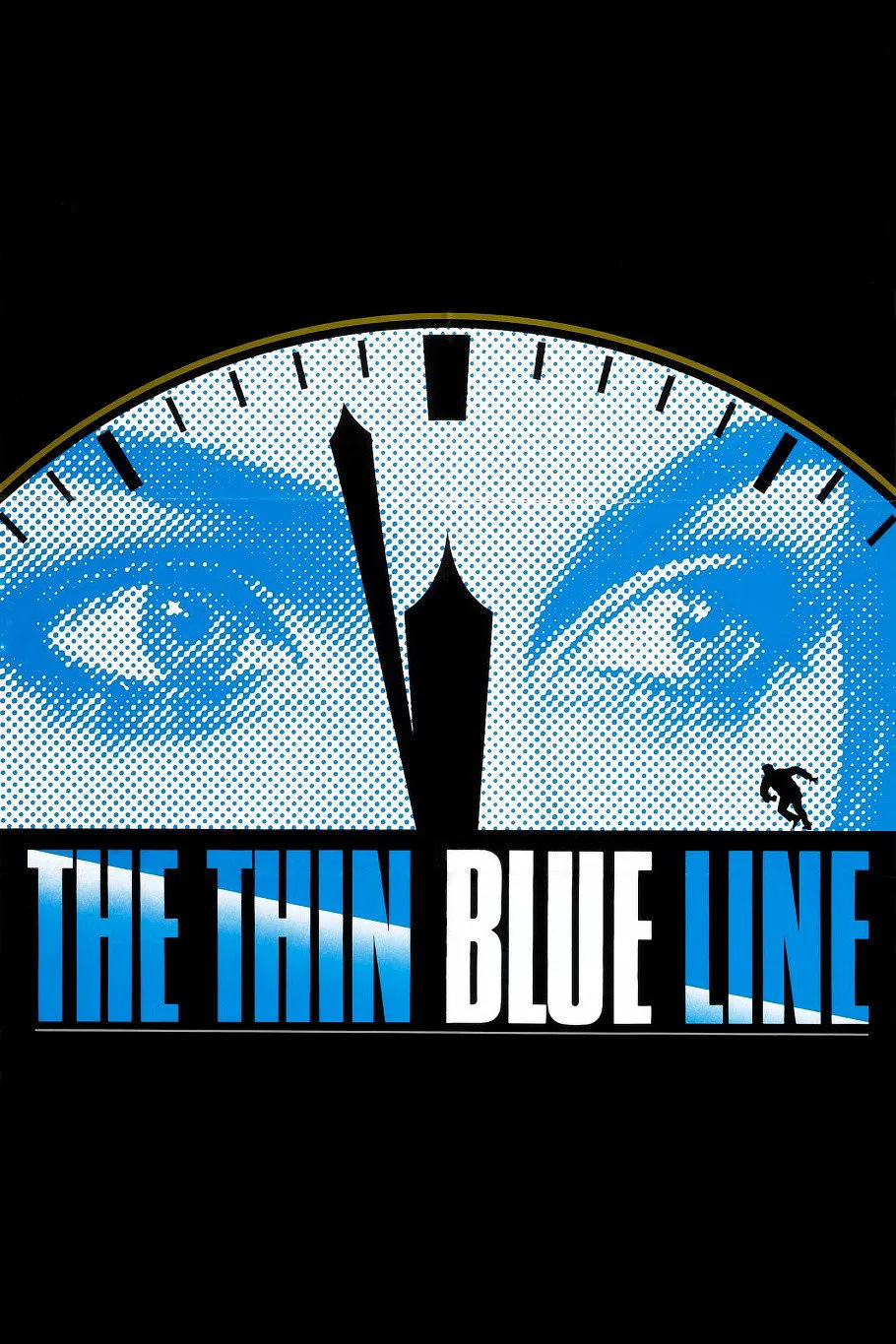
Errol Morris and His Films
Errol Morris is a director whose method of filmmaking involves an amalgamation of poetry, quantum mechanics, and spiritual questioning. He is a poetic director who cultivates the subject matter of his films as a gardener would a rose; allowing it to bloom under his care and guidance, trimming it to his aesthetic ideal, yet leaving the natural integrity of the plant intact.
Objective reality does not have any place in our fundamental description of the Universe, but action at a distance, or acausality does have such a place.
— John Gribbin, In Search of Schrodinger’s Cat (p.183)
Throughout this paper I will be referring to two of Morris’s films: A Brief History of Time and The Thin Blue Line (BHT and TBL respectively). They are the clearest examples of the running themes in all of Morris’s work.
In the article, Mirrors Without Memories1, Linda Williams points out that Morris takes an indirect approach to the truth. Instead of presenting “The Truth,” he presents many versions of truth in an attempt to reflect a more dynamic creature. In his documentaries, as with Medusa, we escape the spell (in our case, our assumed version of reality) and are able to clearly see the nature of the beast only by examining its reflection. In TBL this takes place in the constant reenactment of events – altered slightly by each person’s testimony.
Williams also mentions Morris’s attempt to reconstruct the past in the present (or even the present in the present) by identifying reflective patterns – traces of repetition. She labels this “postmodern,” but nowhere in her definition of this term does she mention that Postmodernism is significantly bound up with Quantum Mechanics. This association is important because of Morris’s involvement with science: specifically, his work as a private investigator and his work on A Brief History of Time. Criminal Investigation is a science of people, and Morris uses his skills in science as well as his knowledge of people to augment his documentaries. In the following excerpt from an interview with Morris by the Onion AV club, Morris talks about the relationship between P.I. work and documentary filmmaking:
O: Do you think your experience as a private detective has helped you as a documentarian?
EM: Well, you know, I was a private detective before and after I became a documentarian.
O: That’s what you were doing between Vernon, Florida and The Thin Blue Line.
EM: Right. I mean, I think they both have informed each other, because there’s a great similarity between the two. I mean, the kind of private-detective work I did, I was sort of on the high end of investigation, because I was a Wall Street investigator doing really, really huge cases. But when you clear aside all of the fancy frills about private investigators and private-detective work, it really comes down to people talking to each other and people being willing to give you information about themselves. Nothing really more than that. That’s the essence of it.2
What Williams brilliantly identifies in Morris’s work is the notion fundamental to Quantum Mechanics: that, as John Gribbin puts it in In Search of Schrödinger’s Cat : “In the quantum world, what you see is what you get, and nothing is real; the best you can hope for is a set of delusions that agree with one another.”3 This is, quite appropriately, “mirrored” in Williams’s article: “we do better to define documentary not as an essence of truth but as a set of strategies designed to choose from among a horizon of relative and contingent truths.”4 In line with this concept, Morris has expressed distaste for documentaries that “go through the same kind of received views that we have about how subjects should be treated, that we all feel comfortable with.”5 In essence, he rejects the standard assumptions as to how we should view something and is ok with taking risks and possibly even making his audience feel uncomfortable. His documentaries never answer all of the questions that they raise, because they are an examination of Life, which is never neat and tidy. Morris’s work is thus designed to help us to develop this skill of seeing indirectly – of using new structures, new patterns of seeing. In much the same way as a Buddhist attempts to achieve enlightenment through a new way of approaching daily, mundane activities; Morris offers the viewer a new way of approaching reality.
To do this, Morris employs many tools that are commonly used in the production of fiction films to shape the full aesthetic of his movies. These tools include: stylized reenactments, clips from movies, music, editing, color manipulation (esp. important in The Thin Blue Line), and more. He uses simple, metaphoric images and slow motion to dramatize the monologues given by his interviewees. An example of this in TBL is the visual representation of the murdered cop’s partner spilling a chocolate milkshake. That she threw the milkshake indicates she was distracted during the murder and was most likely sitting inside the police car though she claims to have been outside, standing. In the reenactment the woman is shown inside the police car drinking the milkshake. Immediately after the cop outside is killed there is a dramatic shot of the woman’s hand releasing the milkshake, a separate shot of the milkshake flying through the air, and a final shot of the milkshake pouring out onto the asphalt. Then a diagram is shown with a mark where the milkshake fell in relation to the car, with the label: “choc. liquid” next to it. There is no other explanation offered visually or otherwise and so what stays with the audience is the notion that the woman lied about being outside of the car. Also, the audience maintains the feeling that the validity of her observations may be somewhat questionable since she was occupied with the milkshake. In this way, Morris uses many dramatic techniques to drive home his point. While never interfering with the evidence, he is selective in what he dramatizes and even in what he chooses to show.
The editing in Morris’s films directly manipulates time, and subsequently, our understanding of causality. In TBL particular events are revealed to us before the events that preceded them. For instance, we learn that Randall Adams was a suspect before we learn that David Harris was his accuser and the initial person arrested. In BHT Stephen Hawking’s life is presented as a chronology, even as the subjects of the non-linear nature of time and the unstable notion of causality are discussed and explained. It is a subtle presentation of perceived time (linear time) vs. the mechanics of time (which is non-linear).
The back-forth motion of TBL is representative of the scientific acquisition of knowledge. Gribbin describes the process of learning quantum physics thus: “you have to learn one thing, then backtrack to learn something else, then move forward to discover just what it was that you learned first of all.” It calls into question the validity of our perceptions of causality and time. In BHT this is not present in the structure of the movie, but it is integral to the subject and pontificated over throughout the film.
Music is integral to the emotion of TBL and BHT. Philip Glass composed the music for both TBL and BHT and he described the process implemented by Morris to be “poetic”. To prepare for the musical composition in BHT Morris handed Glass a list of words (science, black hole, etc.) and asked him to think about what each of the words meant; how they made him feel. As a result, the musical score for BHT evokes a wide range of emotions. It is music composed from a reflection on feelings and intuition and thus evokes these responses from the listener.6
Another significant element of Morris’s work is that he is an indirect subject in his films (the audience is as well, though more removed). We do not see him, we only see the results of his presence. He never speaks except in a tape recorded fragment at the end of TBL and it is never made clear that Morris is the person who is speaking (interviewing Harris on tape). The questions Morris asks his subjects must affect the answers they give, yet the questions are never shown; much as our assumptions affect our perceptions though we may not be aware of them. This also has a parallel in Quantum Mechanics as illustrated by another quote from Gribbin: “First, we have to accept that we, the observers, are in a very real sense part of the experiment – there is no clockwork that ticks away regardless of whether we look at it or not. Secondly, all we know about are the results of the experiments.”7
Morris acknowledges that he is a part of the experiment, indeed, that he should be. He tries so much to actually merge with the “experiment” of documentary that he created the Interrotron, a device which displays his face over the camera lens so the people being interviewed can look directly at him, and out into the audience as well. He has said: “There is no reason why documentaries can’t be as personal as fiction filmmaking and bear the imprint of those who made them. Truth isn’t guaranteed by anything.”8
Documentary as presented by Morris is a kind of meditation, a contemplation and reflection on our place in the universe. It is an examination of our processes and an invitation to expand our notion of reality along with what and who we are. In his own words, it is “biography as dreamscape”9: A deep reflection of our-selves in many forms. Consciousness as consciousness is conscious of itself and a powerful inquisition as to our place in the Universe.
Dec 13, 2000
Footnotes
-
Mirrors Without Memories: Truth, History, and the New Documentary, Linda Williams, Film Quarterly v.46(3) 1993, (pg. 14/305) ↩
-
The Onion AV Club: - archived at https://web.archive.org/web/19991109190704/http://avclub.theonion.com/avclub3218/avfeature3218.html ↩
-
In Search of Schrodinger’s Cat: Quantum Physics and Reality, John Gribbin, 1984, (pg. 162) ↩
-
Morris as quoted by Williams; see #1 (pg. 13/316) ↩
-
The Onion AV Club (see #3): ↩
EM: “It became for me this question of, where are we? Where do we belong in all of this? If we project ourselves onto the world, or onto animals, or onto nature… And yet these worlds themselves may just be strange mirror images of ourselves. Where are we in all of this? There’s a mystery at the heart of the movie that I like. I mean, I like for example that with The Thin Blue Line, people can talk about this movie and say, “Okay, he solved this major murder mystery in Texas.” But, of course, there’s a mystery that remains at the end of the movie of why it all happened. How Randall Adams, for no reason, almost ended up strapped into an electric chair in Huntsville, Texas–and also, for almost no reason, had this filmmaker stumble on his case and devote himself to getting him out of prison. It’s the sort of element of fate and caprice that remains very mysterious in that film, and in Fast, Cheap, I think there’s an equal mystery.
O: Without the solution.
EM: Without the solution. There is no solution somehow, to life.”
-
The Making of A Brief History of Time, video, Errol Morris ↩
-
In Search of Schrodinger’s Cat (see #3) (pg. 106) ↩
-
Morris as quoted by Williams; see #1 (pg. 314) ↩
-
The Onion AV Club (see #2): ↩
EM: I like Stephen Hawking very, very much. And admire him. You know, there’s another interesting thing: There’s a series running on PBS called Stephen Hawking’s Universe. And I was talking last night to a friend of mine who’s a professor of theoretical physics at Harvard. I met him in connection with the Hawking movie, and we’ve remained friends. He thought he was going to be on the installment last night, so I watched one of them, and it reminded me of how my movie was different from what people expected it to be. This was straight science pedagogy, using a lot of the same energy from my Hawking movie. It nevertheless became a kind of exercise in the ABCs of how the universe works. My movie was never about that. It was about Stephen Hawking’s dream about his science, the story of his own biography–but not biography on a kind of factual level, but biography as dreamscape. Of how he himself views his own work, about his own personal or emotional connection to the universe. Which is what I felt about the book, too. I looked at the book as a romance novel, not as an exercise in science instruction. It made me like my movie more, looking at that thing. I’ll tell you that much.