"Do you fancy a pizza? Come on, then! Come on, let's go! What the hell. We might as well go out in style. What's the point in worrying about it all?"
- The Bicycle Thieves
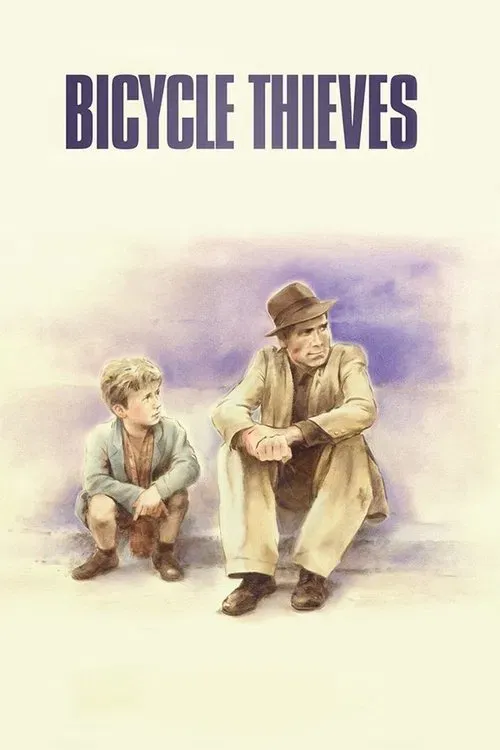
The Bicycle Thieves
The mise-en-scene of the Piazza Vittorio scene in The Bicycle Thieves communicates both the loss of structural integrity in Italian Society at the time of the movie, and Antonio’s desperate hope and underlying despair.
The initial market scene is carefully choreographed to epitomize a kind of planned chaos. As the camera pulls us through a dizzying assortment of bicycle parts, our mind whirls along with it. We assume that all or most of these parts are from stolen bikes because Baiocco has told Antonio that stolen bikes are disassembled and sold here, and upon reaching the market one of Antonio’s friends exclaims “it makes my blood boil!” referring to the sea of stolen parts. The reluctance of one salesman to allow Antonio to look at the serial number of the frame he is painting reaffirms this assumption. Even when it is revealed that the frame is not Antonio’s, it seems likely that it is stolen.
The market is full of people in deliberate movement, each occupied with his or her own individual task. Many people are passersby or shoppers, but their browsing is not casual, it seems directed - as though they know already what they want and are in a rush to get it. When there are shots of people standing still, the noise is escalated, giving the impression of an extremely busy atmosphere, even when the motion is stagnant. One of these passersby walks at a slightly slower pace than the rest - but fills the air with busy bubbles; wand and bottle in hand. The salesmen themselves are animated, as Antonio’s group passes by two of them, they begin arguing loudly. As the background to Antonio’s pensive, strained quietude, this feud creates an aggravating tension.
The lighting in the Piazza Vittorio scene seems to come from natural sources but it is significantly bright; almost garishly so, as the sun glances sharply off the endless lines of bicycles in the marketplace. The salesmen are almost uniformly wearing white shirts and black pants. Their shirts boldly reflect the sun, adding to the atmosphere of loudness in sight and sound.
The motif of the circle fills this scene - creeps slyly into every open space to remind us that this movie is not about just one man - the plot is cyclical, the man who is wronged commits the same crime that was done to him. There are wheels everywhere, hanging high and low in the market place. The wheels that catch our attention the most are metal and rubber hoops - all parts of bicycle wheels. The bubbles that are blown by the man in the background augment this circular theme. The proliferation of circles also hints at the abstraction of the subject matter. This is about more than one man and his family; this is about a cyclical pattern, utterly integral to the mechanics of the Italian society (at the time of the movie). It is commentary about this devastating cycle, exemplified in Baiocco’s words as they peruse this first market: “It is useless to stick together.” And, as the characters discover through the course of the film, it is useless to fight alone.
Unity seems to be the only hope, but there are many subgroups united against one another, to survive in the political battleground of life. The rich eat in fancy restaurants, and own pawnshops, trading money for people’s precious belongings - they are united in their arrogance and disregard for the people beneath them. The poor form tight groups - gangs, if you will, and defend their own (as the mob of people outside the brothel ridiculed and harassed Antonio for accusing their friend of theft). Antonio’s own group is tiny, and not much use to him. The many classes and social groups in this movie can be viewed as the spokes in the wheel of Italian Society. The constant battalion of bubbles and bicycle wheels emphasizes the fragility of the circle with no center. The metal hoops and rings of rubber all lack the strength of a metal wheel with a hub and solid spokes.
The “spokes” of Italian Society are shown to be lopsided in the amount of weight that they carry. The rich hold the power, while the poor bear the brunt of labor and responsibility. Just as no real bicycle wheel can be strong without the weight distributed evenly, the metaphorical wheel of Society must also strengthen each spoke in unison with the others for the integrity of the whole to endure. Thus Unity, the society as a whole, is salvation; and unity, signifying the various social groups, can either be the obstacle or boon to salvation. The unity of small groups can either arise out of defense or support; and the harmony of interaction between those small groups is vital to the health of their society.
While there is a grand current of hopelessness throughout the film, the overwhelming jumble of bicycles in the first marketplace offers a strange sense of hope. The sheer number of bicycles present decreases Antonio’s chances of finding his bicycle, but it also increases the chances that the bicycle is there. For instance, if Antonio found only one bicycle for sale, the chances of it being his would be extremely low. This sense of hope also is reflected in the activity and bright light of this initial marketplace, with the discordant arguments and garish intensity of the light undercutting the effect and suggesting that beneath the hope and unity lie despair and disparity.
There are no definitive solutions offered in The Bicycle Thieves, but the mise-en-scene in the Piazza Vittorio communicates the problem so wholly, that alongside the devastation of the moment, we are filled with a sense of understanding, of hope. Whenever a problem is fully understood, a solution is sure to be lurking nearby. If we know what the cause and implications are of a disease, we can begin developing methods to prevent and eradicate either the disease itself or the possibility of contagion.
Sept. 18, 2000